flowchart LR
  A[Collect 30 real prompts] --> B[Generate answers]
  B --> C{Score with rubric}
  C -->|pass| D[Ship]
  C -->|fail| E[Change prompt or model]
  E --> B
A tiny rubric for evaluating LLM answers
AI
Python
evaluation
You don’t need a framework to start evaluating model output. A spreadsheet-sized rubric and twenty lines of Python get you surprisingly far.
Most teams wait too long to evaluate their LLM features. They’re looking for the right framework when a small, honest rubric would already tell them most of what they need.
The loop
The rubric
Three criteria, each scored 0–2. Keep it boring, keep it consistent.
import pandas as pd

scores = pd.DataFrame({
    "variant":  ["Baseline", "Baseline", "Baseline", "New prompt", "New prompt", "New prompt"],
    "criterion": ["Correct", "Grounded", "Concise"] * 2,
    "score":    [1.2, 0.9, 1.6, 1.7, 1.5, 1.4],
})
scores.pivot(index="criterion", columns="variant", values="score")| variant | Baseline | New prompt |
|---|---|---|
| criterion | ||
| Concise | 1.6 | 1.4 |
| Correct | 1.2 | 1.7 |
| Grounded | 0.9 | 1.5 |
What changed
import matplotlib.pyplot as plt

wide = scores.pivot(index="criterion", columns="variant", values="score")
ax = wide.plot.bar(rot=0, width=0.7)
ax.set_title("The new prompt wins on correctness and grounding")
ax.set_xlabel("")
ax.set_ylim(0, 2)
ax.legend(title="")
plt.show()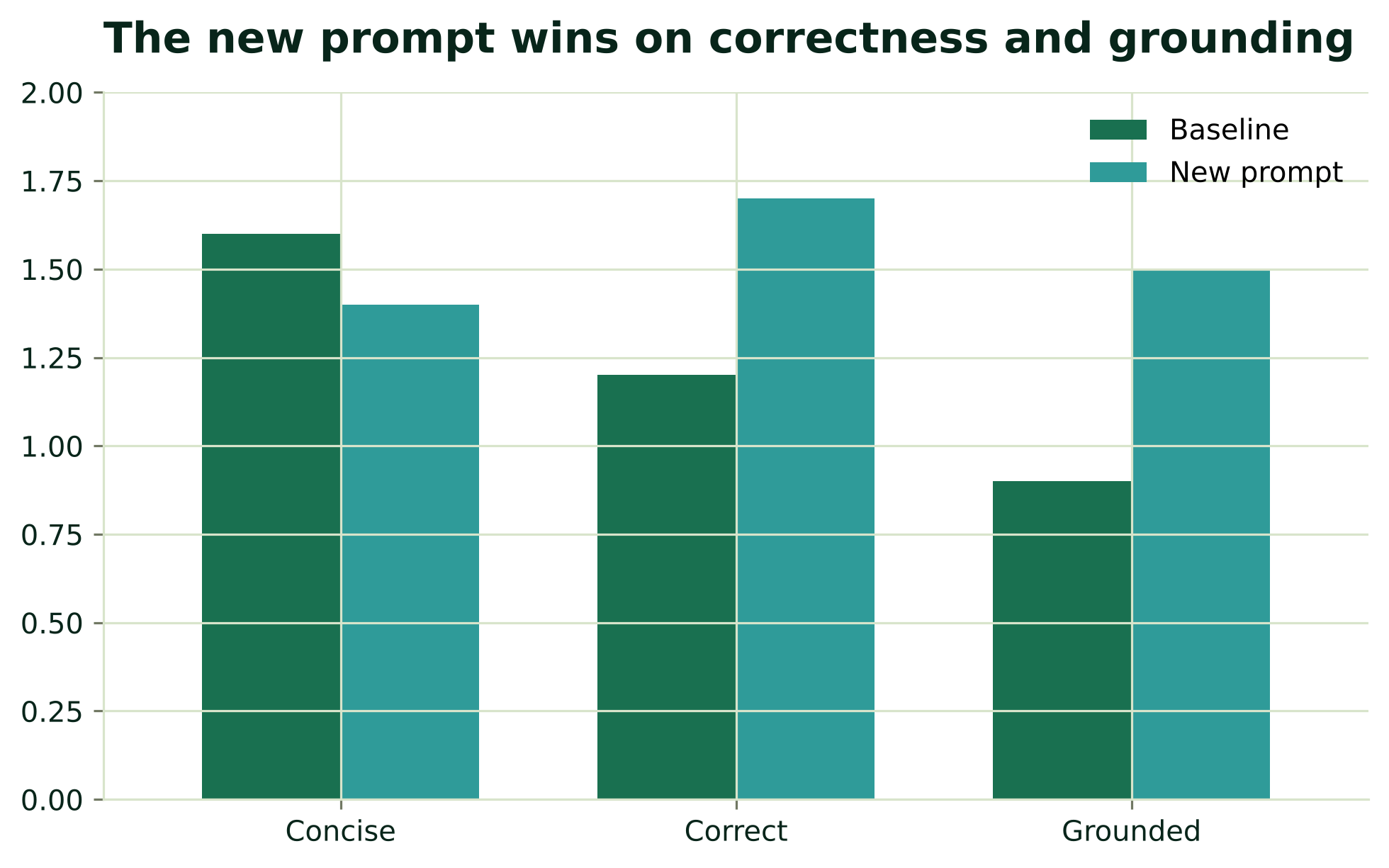
TipRule of thumb
If every change “wins”, your rubric isn’t sensitive enough. Add a harder prompt or two.
Evaluate early, evaluate small, evaluate often.